Politics, Literature and National Character by Madame de Stael
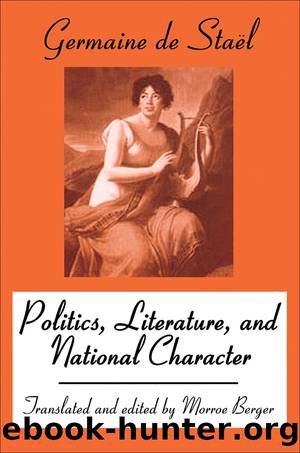
Author:Madame de Stael [Stael, Madame de]
Language: eng
Format: epub
ISBN: 9780765806451
Publisher: TaylorFrancis
Published: 2017-09-15T00:00:00+00:00
Chapter X. Italian and Spanish Literature
The patronage of the princes of Italy contributed much to the Renaissance but it necessarily hindered philosophy. This hindrance would have persisted even if religious superstition had not in several ways adulterated the search for truth.
We must recall here once more the meaning that I have consistently attached to the word philosophy in the course of this work. I call philosophy the investigation of the source of all political and religious institutions, the analysis of the personalities and events of historyâin short, the study of man and of the natural rights of man. Philosophy in this sense presupposes freedom or must lead to it.
The men of letters of Italy, needing the money and the approval of the princes to recover the ancient manuscripts that were to serve them as a guide, were further than those of any other country from that sort of independence necessary to philosophy of such a kind. There was a host of academies and universities in the large cities of Italy. These associations were singularly fitted for the scholarly labors that were to bring so many masterpieces out of oblivion. But public establishments are by their very nature completely obedient to governments. Public bodies, like Estates, social classes, and religious sects, are extremely useful for some specific purposes but are much less favorable than individual efforts and talent to the continuous advancement of philosophical learning.
We should add to these general considerations that the long and patient research required to examine and analyze ancient manuscripts particularly suited the monastic life; and it was indeed the monks who were the most actively engaged in literary studies. Thus the very causes of the rebirth of literature in Italy set themselves against the development of natural reason. The Italians cleared the first passage in the road along which the human mind has since made such great progress, but they themselves were fated never to advance on the path they had opened.
Poetry and the fine arts, by their unique charms, intoxicate the imagination, but the writers in prose are, in general, neither moralists nor philosophers and their attempts at eloquence produce only exaggeration. Nevertheless, as it is the nature of the human mind always to go forward, the Italians, to whom philosophy was forbidden and who could not in poetry go beyond perfectionâthe limit of all the artsâwere renowned for the remarkable progress they steadily made in the sciences. After the age of Leo X, after Ariosto and Tasso, their poetry declined; but they had Galileo, Cassini, and others; and even recently many useful discoveries in physics have associated them with the intellectual improvement of the human species.
Superstition indeed tried to persecute Galileo, but several princes of Italy itself came to his help. Religious fanaticism is the enemy of the sciences and arts as well as of philosophy, but absolute monarchy or feudal aristocracy often protects the sciences and the arts while detesting independence only in philosophy.
Let us examine in each branch of human understanding, in philosophy, eloquence, and poetry, the causes of the successes and faults of Italian literature.
Download
This site does not store any files on its server. We only index and link to content provided by other sites. Please contact the content providers to delete copyright contents if any and email us, we'll remove relevant links or contents immediately.
Personalized inhaled bacteriophage therapy for treatment of multidrug-resistant Pseudomonas aeruginosa in cystic fibrosis by unknow(214656)
CONSORT 2025 statement: updated guideline for reporting randomized trials by unknow(102521)
Critical evaluation of the ProfiLER-02 study design and outcomes by Vivek Subbiah & Razelle Kurzrock(102046)
Cardiac gene therapy makes a comeback by Oliver J. Müller & Susanne Hille & Anca Kliesow Remes(101838)
Whisky: Malt Whiskies of Scotland (Collins Little Books) by dominic roskrow(74619)
Unveiling the design rules for tunable emission in graphene quantum dots: A high-throughput TDDFT and machine learning perspective by Şener Özönder & Mustafa Coşkun Özdemir & Caner Ünlü(51002)
A yeast-based oral therapeutic delivers immune checkpoint inhibitors to reduce intestinal tumor burden by unknow(40374)
Covalent hitchhikers guide proteins to the nucleus by Alexander F. Russell & Madeline F. Currie & Champak Chatterjee(40296)
Meet the Authors: Christopher R. Mansfield and Emily R. Derbyshire by Christopher R. Mansfield & Emily R. Derbyshire(40208)
Alkaline-earth metals promote propane dehydrogenation with carbon dioxide through geometric effects: Altering the reaction pathway by unknow(32814)
Induced iron vacancies boosting FeOOH loaded on sustainable Fenton-like collagen fiber membrane for efficient removal of emerging contaminants by unknow(32610)
Efficient electric-field-assisted photochemical conversion of methane to n-propanol exclusively over penetrated TiO2Ti hollow fibers by Guanghui Feng(32530)
Bi2SiO5 nanosheets as piezo-photocatalyst for efficient degradation of 2,4-Dichlorophenol by Hangyu Shi & Yifu Li & Lishan Zhang & Guoguan Liu & Qian Zhang & Xuan Ru & Shan Zhong(32468)
A novel NDIPTA organic heterojunction photocatalyst with built-in electric field for efficient hydrogen production by Jiahui Yang & Baojun Ma & Yongfa Zhu(32443)
Enhanced conversion of methane to liquid-phase oxygenates via hollow ferrite nanotube@horseradish peroxidase based photoenzymatic catalysis by Jun Duan & Shiying Fan & Xinyong Li & Shaomin Liu(32405)
Ordered macroporous superstructure of defective carbon adorned with tiny cobalt sulfide for selective electrocatalytic hydrogenation of cinnamaldehyde by Xiao-Shi Yuan & Sheng-Hua Zhou & San-Mei Wang & Wenbo Wei & Xiaofang Li & Xin-Tao Wu & Qi-Long Zhu(32335)
What's Done in Darkness by Kayla Perrin(27258)
Topological analysis of non-conjugated ethylene oxide cored dendrimers decorated with tetraphenylethylene: Insights from degree-based descriptors using the polynomial approach by A Theertha Nair & D Antony Xavier & Annmaria Baby & S Akhila(26631)
Investigation of mechanical and self-healing properties of hydroxyl-terminated polybutadiene functionalized with 2-ureido-4-pyrimidinone by Mohsen Kazazi & Mehran Hayaty & Ali Mousaviazar(26555)
